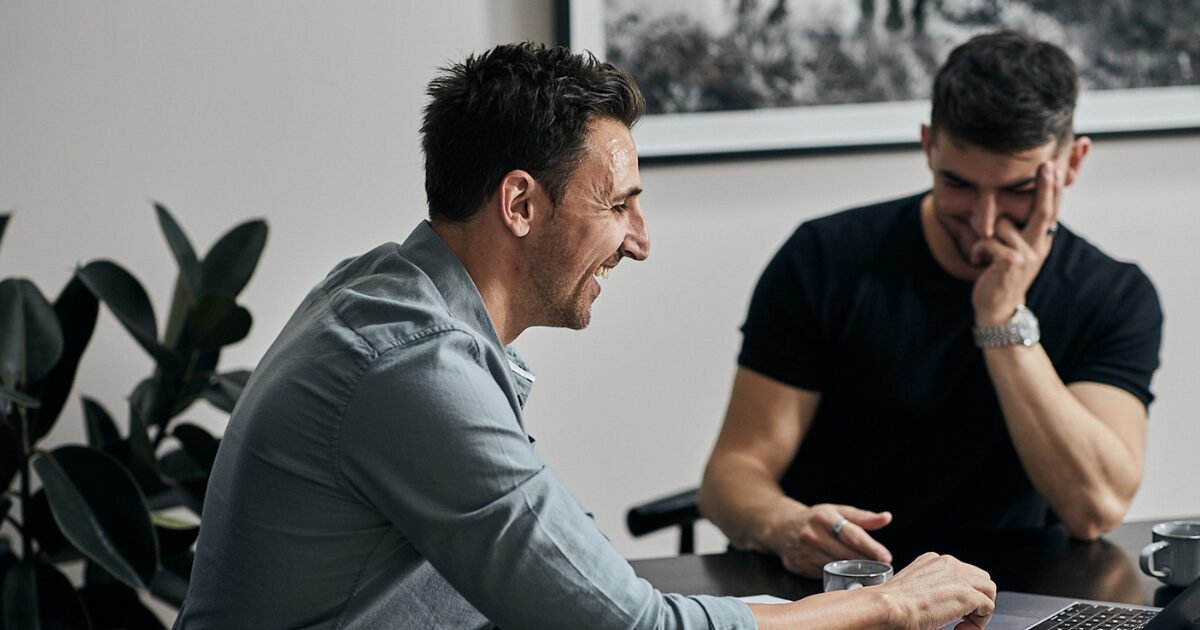
Adrian here, with the first-ever Adrian Unfiltered episode. Same podcast, just me on my own, talking about the things I’ve spent years learning, unlearning and putting into practice with the people I work with and in my own life.
I’ll be honest, I was nervous recording it. My mouth went dry, my heart picked up, that tingle in my fingers. So I asked myself the same question I’ve learnt to ask whenever it shows up. Is this actually nerves, or is it excitement? Because physiologically, they’re identical. The dry mouth, the dilated pupils, the heart rate, the butterflies. Same set of signals every time.
The only thing that decides which one we call it is the story we tell ourselves. Think of two kids in the queue at Movie World for the same ride. One is terrified, and the other one can’t wait. Same circumstances. The only difference between them is what they’re saying in their own head.
So that felt like the right place to start for my first solo episode because confidence isn’t something you either have or you don’t, it’s built. And it gets built on the back of the story you’re running, whether you chose that story or not.
The Voice In Your Head Isn’t You
The voice in your head that narrates your fears, your shoulds, your what ifs. Is that voice actually you?
Because if it is, then who’s the one listening?
Most of what that voice says was never ours to begin with. It’s built from everything we absorbed as kids. The experiences, the knowledge we took on from parents and teachers, the offhand comments that landed harder than anyone realised. Over time, all of that hardens into belief and we treat belief as fact. We stop questioning it. We just let it drive.
In positive psychology, there’s an idea about giving that voice a name, recognising it as a separate thing to you. Not because it isn’t built from your own subconscious, it is, but because naming it gives you something the autopilot doesn’t want you to have. Distance. The ability to catch it mid-sentence and ask one simple question. Is this thought serving me, or is it sabotaging me?
The more you can say that out loud, the more you start steering instead of being steered.
The voice in your head isn’t you. If it was, then who’s the one listening?
For a long time, I didn’t have confidence. None of the out-of-the-box kind some people seem to naturally have.
I was a skinny kid, long hair down past my chest, somewhere between a Hanson brother and Bon Jovi depending on who you ask. So I did what a lot of us do when we don’t trust ourselves. I avoided. I people-pleased. I stayed out of any situation where I might get rejected, because a no would have done real damage to what little self-belief I had. My whole story, the one running on autopilot, was built around not getting hurt.
What’s interesting looking back is that the things that started to change it weren’t comfortable. They were the opposite.
The Bungee Jump
I was 16, on a family holiday on the Gold Coast over Christmas. There was a bungee jump set up near Cavill Avenue and I decided I wanted to do it. Everyone knew I was scared of heights. There was a fair bit of debate, Mum and Dad were not keen, but I ended up at the top of that crane.
I was shitting myself. The fear was not abstract. It was in my body, that full paralysis, hanging onto the bars for dear life while a very encouraging bloke told me to shuffle towards the edge. Then the count. Three, two, one, bungee.
I jumped.
I can still picture that moment. Basically horizontal, the world stopped for what felt like ten seconds or maybe a lifetime. Then the cord caught and everything came rushing back. The endorphins, the fear, the relief, all of it at once. By the time I got back on solid ground every cell in my body was lit up. I didn’t have words for it then, but that was the first time I really understood what being alive felt like. Every bit of focus, every sense, fully in one moment.
I didn’t realise it at the time, but I had put myself in a position where the only thing left was action. You either step off or you don’t. There’s no room for the story.
I put myself in a position where all that was left was action. You step off, or you don’t.
Confidence Is Trust and Trust Is Earned
I love where words come from. The root of confidence is the Latin confidia, which translates roughly as intense trust.
So, to build confidence is to build intense trust. In who? In yourself.
And you don’t build trust in yourself by thinking about it. You build it by doing what you said you’d do.
It’s as ordinary as deciding you’ll go to the gym on Monday. When Monday comes and you don’t go, you’ve quietly confirmed to yourself that your word doesn’t mean much. When you go, even for ten minutes, you’ve added a small deposit to the account. Do that enough times and the trust compounds.
It scales up from there. Ask for the pay rise. Put your name down for the promotion. Say hello to the person you’ve been too nervous to approach. Whether it goes well or badly almost doesn’t matter. You either win or you learn, and either way, you showed up for yourself, which was the whole point.
Your Identity Belongs With The Action, Not The Outcome.
This is the one I drill into nearly everyone I work with because it took me a long time to learn it myself.
I didn’t really experience failure until I went for my first assistant manager role and didn’t get it. Sales had taught me about missing targets, sure, but I’d filed that under the job. This was different. It landed on my identity because I’d built my identity on the outcome rather than the effort.
That’s the trap and society sets it for us. We pin our worth on the success, not on the attempts, the actions, the showing up. But the outcome is the part you can’t fully control. The process is the part you can.
I tell people I’m outcome-driven but process-focused, because it’s the process that lets you fail upwards until the outcome eventually takes care of itself. I have total clarity on the vision. Speaking on stages, for one. Am I there yet? No. So the only useful question is what actions move me closer, today.
Progress over perfection.
We pile so much pressure on ourselves for things to be perfect when all they ever needed to be was progress. Even the smallest step forward counts. Ask yourself, would I have done this last week? Last year? If the answer’s no and today you did it anyway, that’s worth acknowledging. That’s the work.
The 6 Words That Stuck With Me
When I was 24, working at a dealership, one of the senior leaders crossed paths with me outside. It was completely unprompted. He looked at me and said, very clearly, “Adrian, you’re destined for bigger things.”
I’d started to make a name for myself by then and somewhere in the back of my mind I’d wondered if maybe I was more than just a car salesperson. But did I believe it? Honestly, no. And then someone outside my own family said it out loud and it powered me up in a way that’s hard to explain. It took me a long time to act on it, but the words stayed.
Here’s the part that gets me. I crossed paths with him again last year, close to two decades later. I pulled him aside and asked if he remembered saying something to me when I was young. He looked me dead in the eye and he knew the exact moment I was talking about. Twenty years on and he knew exactly what he’d given me.
That’s how much it matters.
A candle loses nothing by lighting another candle.
Can you remember who believed in you outside your own family? That’s how much your words can land for someone else.
The 85-Year-Old Version Of You
There’s an exercise I came across when I was 33 that I still use. The Stoics talk a lot about being comfortable with death. Not in a warrior, ready-to-be-sacrificed way, but as a lens. If you think about the end of your days, how does that change how you show up today? What would you stop wasting? What would you actually say and do?
So picture the 85-year-old version of you. What does he or she want you to do right now so that when you arrive at that age, you’re not saying I wish I had. You’re saying I did it! I closed the gap as much as I could.
That gap, the one between who you are and who you’re capable of becoming, that’s your potential. And once you take away skills and circumstances, what’s left determining how much of that gap you close is self-belief.
You’re going to slip up while you’re building this. You’ll fall short, you’ll fall over. And when you do, that voice inside you tends to get savage. Critical, negative, sabotaging.
So when you hear it, try this.
Ask yourself what you’d say to the person you love most in the world if they were going through exactly what you’re going through. If you feel that softness arrive, that flat refusal to ever speak to them the way you speak to yourself, that’s compassion. That’s common humanity. Now say to yourself what you’d say to them, and say it out loud, because the closest ears to your lips are your own and you need to actually hear it.
I get that negativity can be a fuel. It gets some people across the line. But it isn’t a positive fuel and it isn’t a sustainable one. Think about an Olympic diver who’s done the dive fifteen thousand times and still doesn’t nail it. Twenty minutes later, they’re back on the board. Did beating themselves up get them there in any state to perform? Or was it kindness, repetition and a clear head?
The greatest gift we can give ourselves, and each other, is self-belief. I went looking for mine for a very long time, which is exactly why I now spend my time trying to give it back.
Build it one percent at a time. Do what you say you’ll do and speak to yourself like someone worth believing in because you’re the one listening.
Listen to Episode 07, The Confidence Game, on Apple Podcasts or Spotify.
Until next time,